JIOS — an evidence-first decision system for my own job search
Rules filter. The model reads. I decide. Every label carries its source.
I built JIOS to turn a noisy job search into a decision process I could audit: postings are acquired automatically, screened by deterministic rules, read once by a small language model, and then decided by me, with my decisions becoming the examples for the next reading. It runs three times a day on a server I operate, and it has handled 2,238 postings so far.
Why it exists
A Trust & Safety search in Dublin means watching one specialised board, a dozen company boards, LinkedIn, Amazon and whatever a research agent finds overnight. So far that has produced 2,238 postings, of which 581 are open today. Reading them by hand is not a search, it is a second job. The question JIOS answers every morning is simple: which of these deserve an hour of my day, and why.
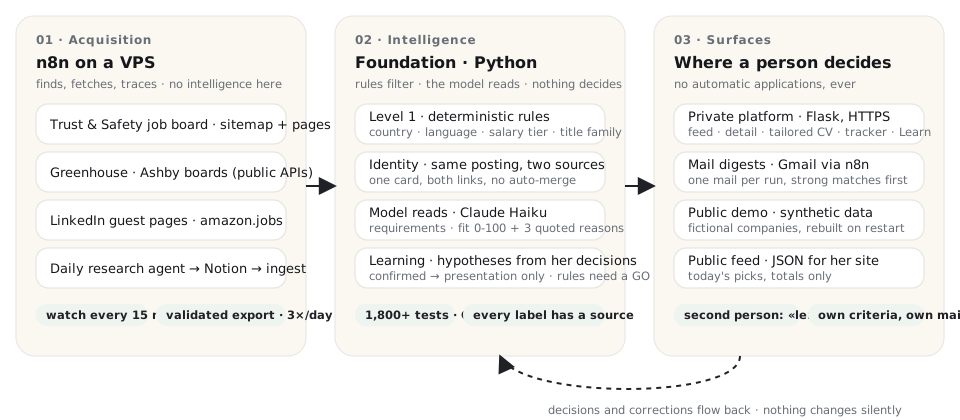
From discovery to a decision
Each stage has one job and one owner. Acquisition finds and fetches; it holds no intelligence. Rules apply the hard constraints only. The model reads the text and explains itself. A person decides. Nothing is applied for automatically.
Scroll to start, or step through.
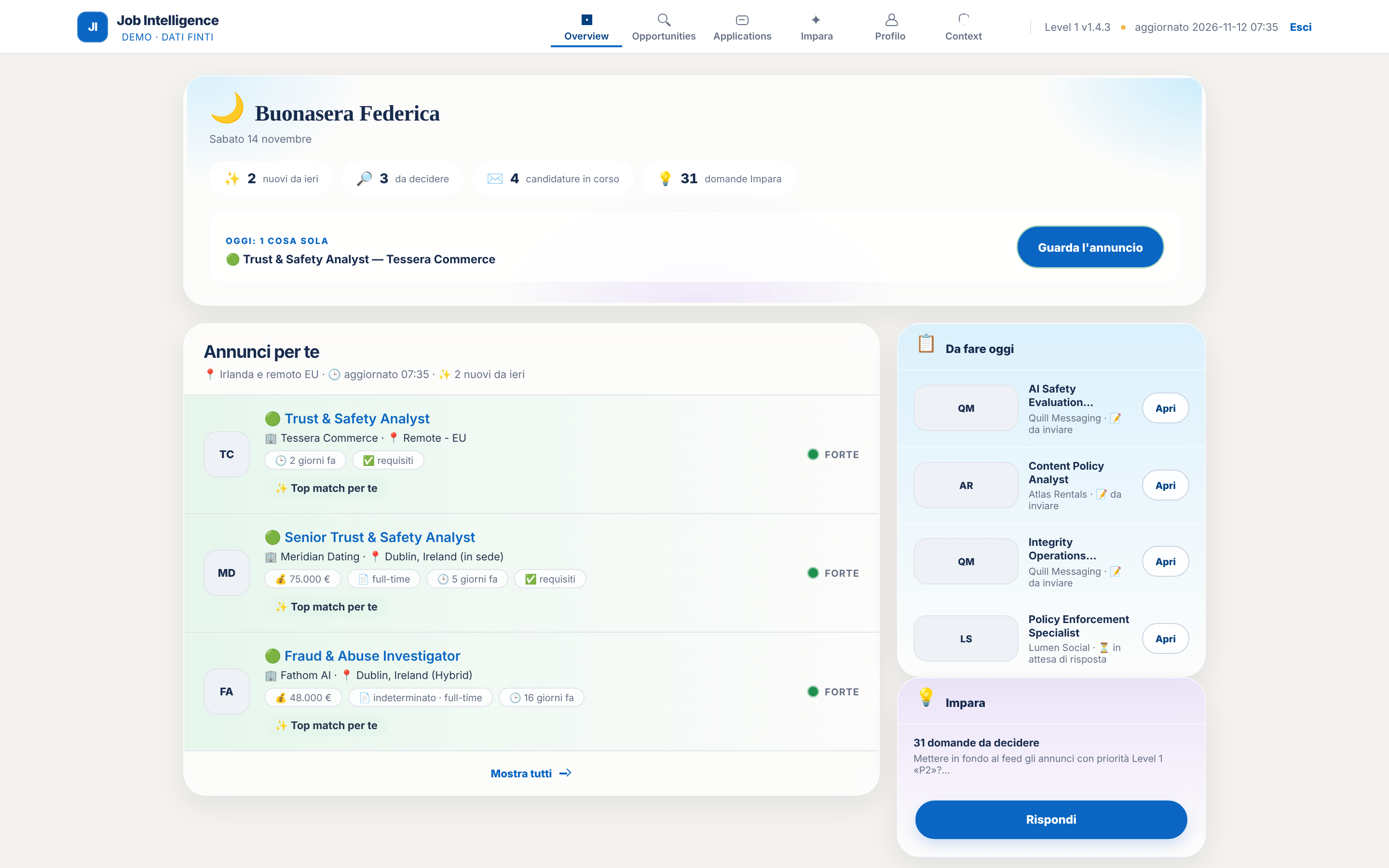
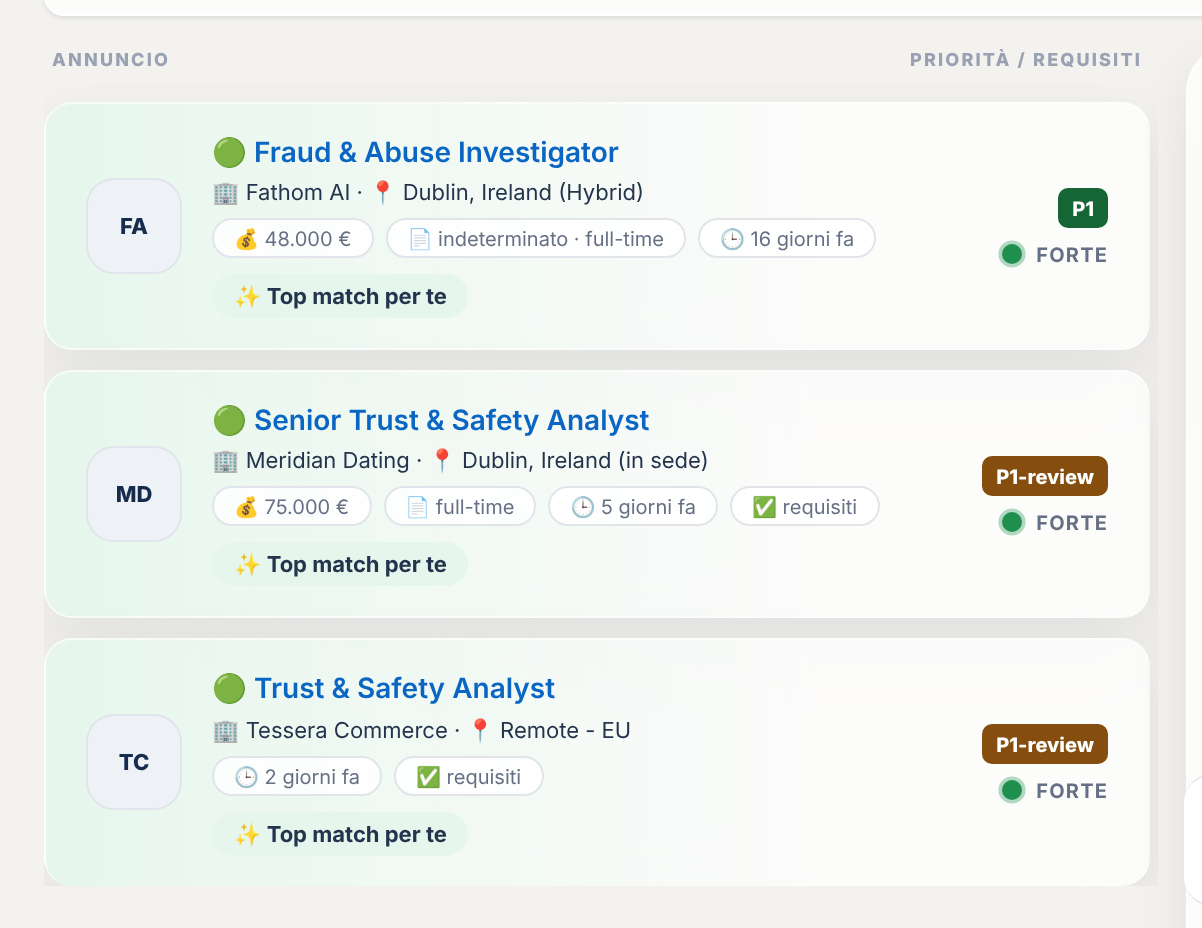
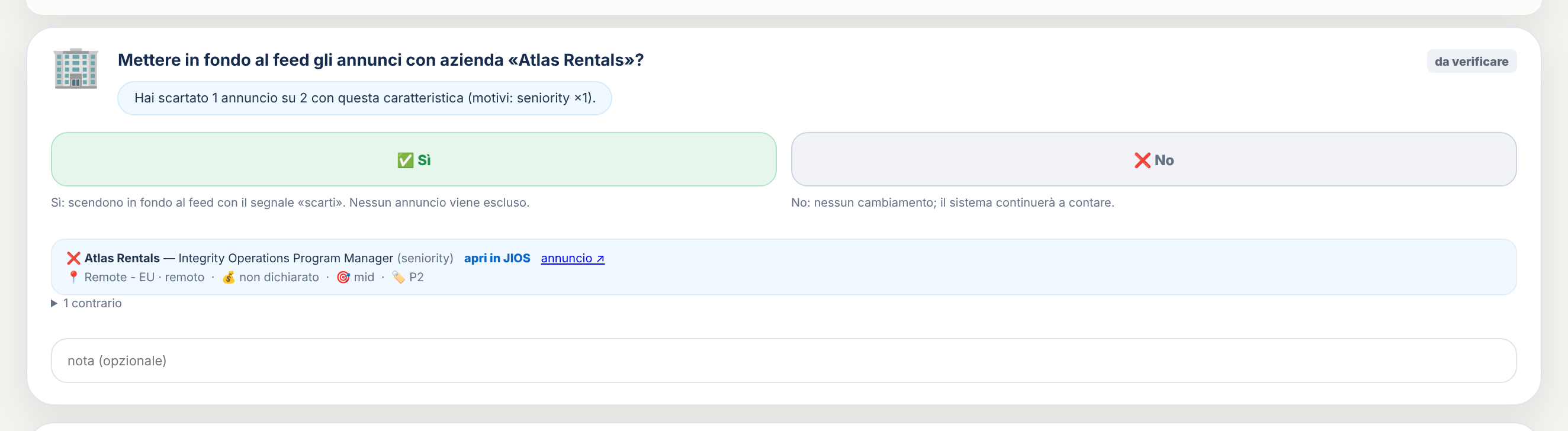
The five stages play above. Three of them are shown below as they appear in the demo; discovery and the rule filter are described in the animation. The interface is in Italian, my working language for the tool; an English version is planned for when the platform opens up.
Filter with rules
Let the model read

Learn
Design decisions
Three I would defend in an interview.
The interface contains no decision logic
The web platform renders what the Foundation computes and records what I choose. If the UI disappeared tomorrow, every decision, score and reason would still be in append-only files with timestamps.
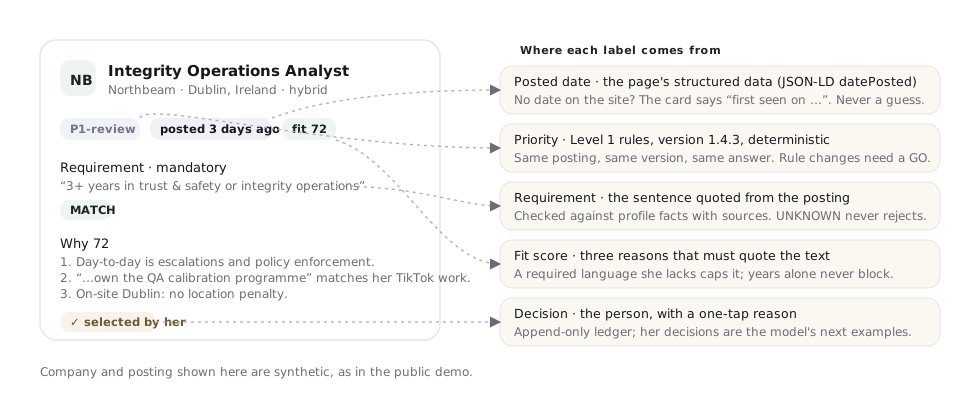
Every label carries its source
A posting date comes from the page's structured data or it is shown as “first seen on”; a priority names its rule version; a requirement is the quoted sentence; a score comes with the reasons that cite the text. Nothing is inferred silently, and an unknown is never a rejection.
Rules filter, the model reads, a person decides
The model is a reader, not a judge: it never discards, never applies, never changes a rule. This keeps costs trivial — about half a dollar of model usage for 446 requirement readings and 420 fit scores — and keeps the accountability where it belongs.
Measured before it ships
A score that nobody has measured is an opinion. Before the fit score went live I held out 65 of my own past decisions that the model had never seen and asked how often a posting I selected scored above one I discarded. The title-based rules alone sat at about 50%, a coin toss. The model reading the full text with my profile and my past decisions as examples reached 92.5%.
I then tried three ways of generating the profile text the model reads from my structured profile facts instead of a hand-written summary. All three scored lower, because the profile's careful CV-integrity cautions (“do not claim…”) read as limits. Only the measured best went to production; the other variants remain selectable for the next round.
| What the model reads about me | Agreement with my decisions |
|---|---|
| Hand-written summary (in production) | 92.5% |
| Generated from all 169 profile facts | 84.8% |
| Generated, summary first, years rule in the prompt | 80.9% |
| Hybrid: summary + my requirement answers | 85.0% |
| Title rules only (baseline) | ≈ 50% |
Same 65 blind decisions for every row. Agreement = probability that a selected posting scores above a discarded one (AUC).
Open questions
False negatives
I only see what the system shows me. A weekly re-read of postings near the threshold is the planned check.
Time per decision
The platform records decisions, not how long each took.
Real outcomes
Applications are tracked to their stage, but 18 applications are not yet a dataset. The honest statement today is: the system is good at agreeing with me, and I do not yet know how good I am.
Under the hood
Python 3.11/3.12 · Flask · n8n on a Hetzner VPS · PostgreSQL and n8n Data Tables for acquisition · Claude Haiku 5.5 for reading · Caddy for HTTPS · systemd timers · Gmail through n8n for the digests. 1,806 automated tests, continuous integration on every push, 288 commits since 11 October 2026. Every runtime store is append-only; the latest row wins and nothing is rewritten. 155 postings decided so far.
About the demo
● Status: private testing. JIOS runs for me only while I test it; the platform will be opened up and made public once the testing phase is complete.
The public demo runs on synthetic data: fictional companies, generated postings, no login, rebuilt from scratch on every restart. My real platform, my decisions and the companies I apply to are never public. The counters on this page are totals only.